
04 / Guards
Acrylic machine guards and housings
A guard has to do three things at once: fit, stay clear, and survive. Fit comes from matching the machine, clarity from sheet and surface, survival from annealing and corner radii. Every model here has been through all three.
04 / Guards
Guards & Covers
Three variables decide whether a guard works: how it mounts, how thick it has to be, and whether the material can take the service environment. Holes are matched to the actual machine frame or its 3D model rather than to a generic drawing, thick sheet is annealed after bending so a corner does not craze, and every external corner carries a radius of at least 3 mm to stop a stress crack starting. Panels run 3 to 20 mm; where impact is real we will say so and quote polycarbonate instead.
04 / Guards
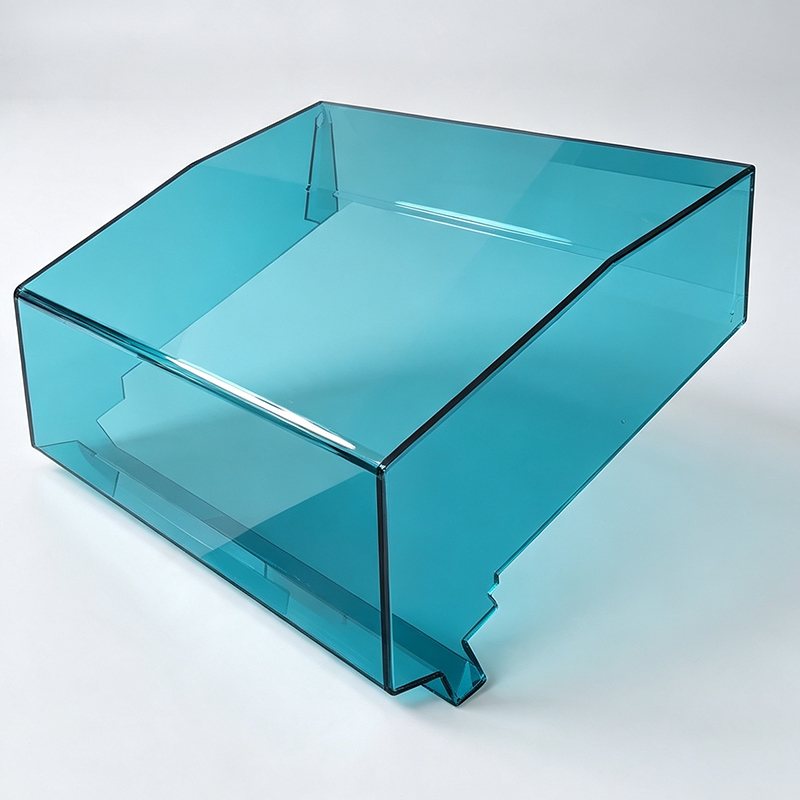
Flip-top protective cover
Hinged lid for machines that are opened constantly; bent to the machine profile, no swing clearance needed.

04 / Guards
Custom protective cover
Drop-in replacement for moulded or sheet-metal covers, matched to the part or its 3D model.
04 / Guards
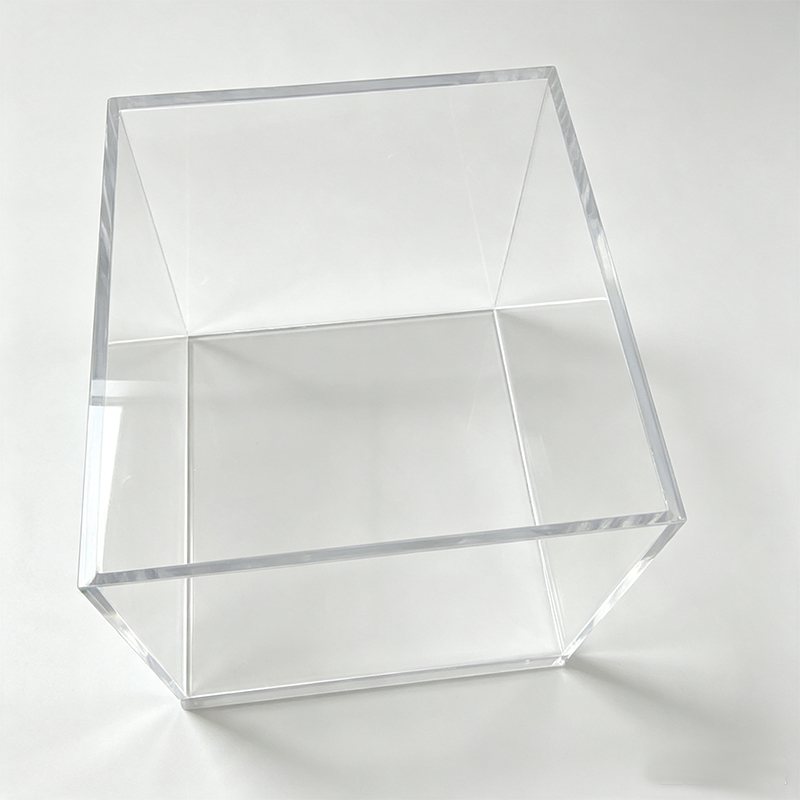
Figure and model clear cover
Dust cover for collectibles with a wood or acrylic base; seams bonded with no visible glue line.
04 / Guards
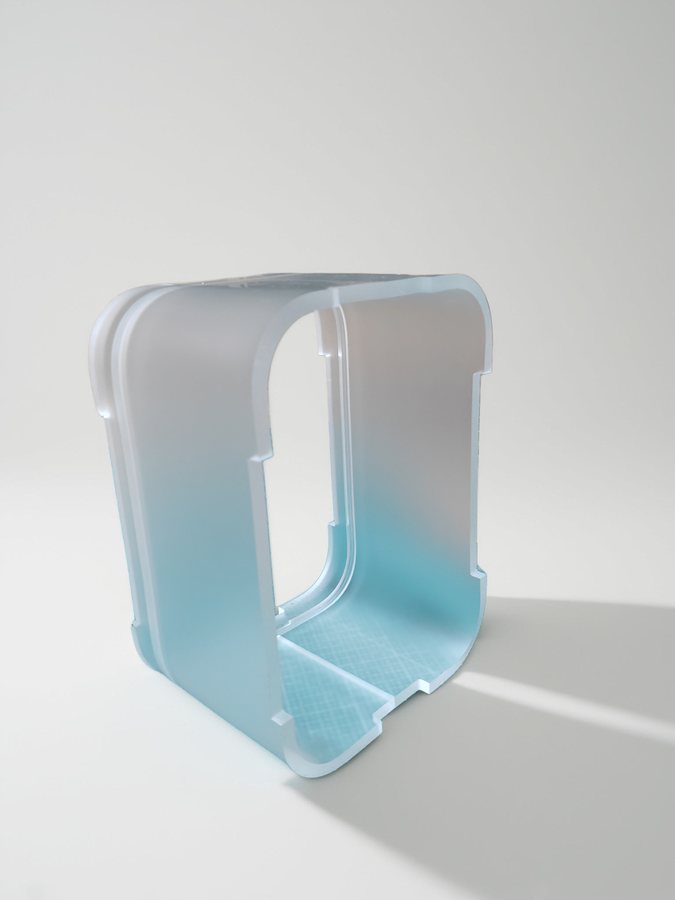
Gradient frosted cover
Machined from thick sheet in one piece; the frosting grades from dense to clear to hide internals but keep a view.
04 / Guards
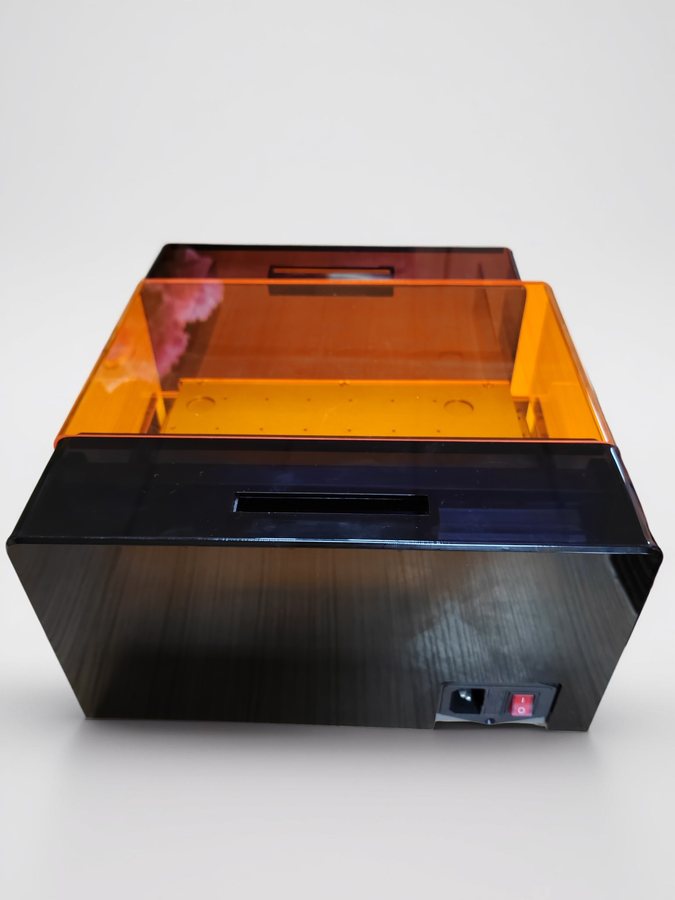
Amber instrument housing
Two-part sliding shell in amber tint that filters part of the blue end, for optical and inspection gear.
04 / Guards
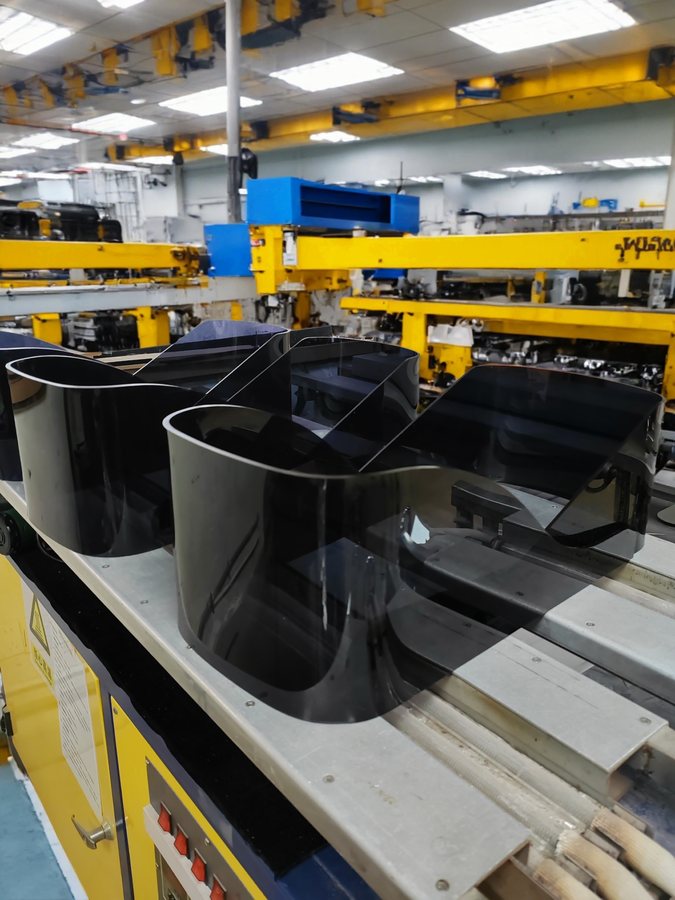
Black heat-bent guard
Black sheet bent in one heat cycle into an arc; radiused corners so nothing starts a crack.
04 / Guards
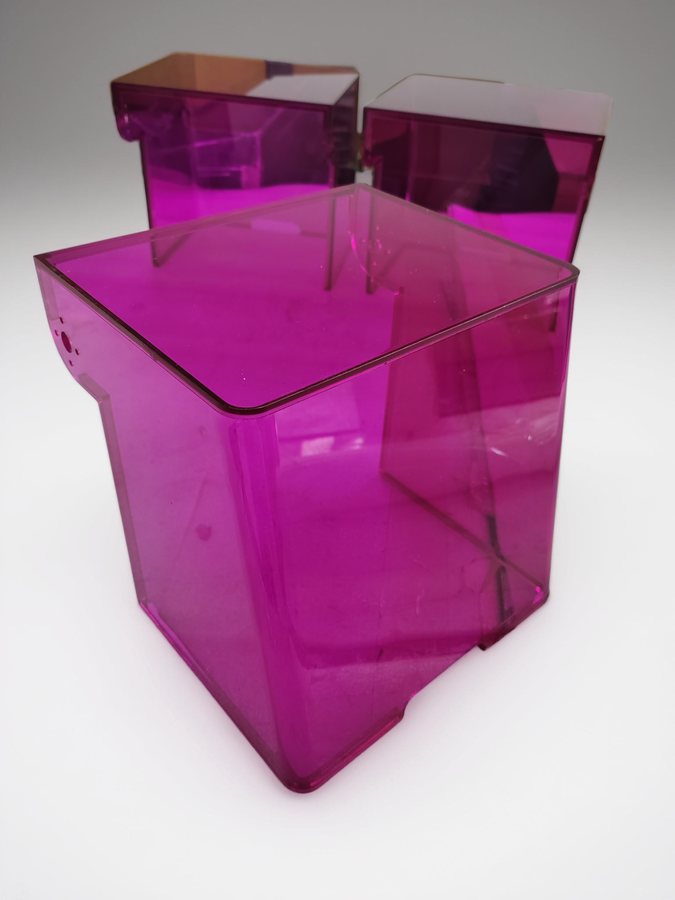
Purple tinted equipment shield
Tinted translucent sheet, bonded, with vent holes; colour can be sampled to your brand reference.

04 / Guards
Instrument chassis housing
UV-stabilised sheet with a hinged lid, clear enough to watch the mechanism, stable under long sun exposure.
04 / Guards
What this line covers
Guards, shields and covers are all the same question asked three ways: what has to be kept out, and what has to be seen through.
Machine-side work is the core: a fixed acrylic machine guard over a spindle or a conveyor, a hinged cover with a stay so it stays open while an operator loads a part, an equipment shield with machined vent slots, and an instrument housing in amber or smoked sheet where the contents are light-sensitive. A sneeze guard for a food counter is a different geometry but the same material logic — 6 mm cast, polished edges, a 200–250 mm pass-through at the base.
Protective work is the second group and the one that reaches consumers: a dust cover for a figure or a model, a display case for a collectible with a rebated base and an optional lit plinth, a dust cover for a sewing machine or a printer, and a flip cover with a piano hinge for something opened daily. On all of these the design question is not thickness but how the cover locates — a cover that slides will scratch what it is protecting.
| Piece | Material and the reason |
|---|---|
| Machine guard | 5 mm fixed, 8 mm on a door, 10 mm facing a moving axis; cast sheet, annealed if bent |
| Impact panel | Polycarbonate, not acrylic — 200 times the impact strength, and it does not shatter into sharp fragments |
| Hinged cover | Full-width bonded piano hinge, friction knuckle or gas strut; two stays above 800 mm wide |
| Sneeze guard | 6 mm cast, 600 mm front, 250–300 mm top return, 200–250 mm pass-through; local code decides the exact gaps |
| ESD shield | Static-dissipative sheet at 10^6 to 10^9 ohms; surface grade decays with wiping, volume-conductive lasts |
| Dust cover | 3 mm five-sided case, open base, rebated location so it cannot slide |
| Display case | 5 mm with its own base, magnetic or hinged lid, optional LED plinth |
| Instrument housing | Amber or smoked cast sheet for light-sensitive contents; split slide-out construction for service access |
Where impact is real we will say so and quote polycarbonate instead, even though it costs more and yellows faster. A guard that shatters is worse than no guard, because the fragments become the hazard.
What to put on the drawing for a guard or cover
| Callout | What we need | Why it matters on a guard |
|---|---|---|
| Opening size | Frame opening, measured, or the STEP file | Sets thickness through the span rule |
| Hole pitch | Pitch, diameter, and distance to the edge | Under 8 mm to the edge is where cracks start |
| Hazard | One line: mist, chips, or a moving mass | Decides acrylic versus polycarbonate |
| Bend and anneal | Bend line and confirmation that annealing is included | Drill before bend, anneal between |
| Corner radius | 5 mm external minimum | A sharp corner concentrates vibration stress |
| Ventilation | Slot width and pattern | Minimum 4 mm with a 1 mm end radius; square ends crack |
Where a guard is a replacement for one that failed, send a photograph of the failure. Where a crack began tells us more about the correct specification than the drawing does — a crack from a hole points at mounting, a crazed bend points at annealing, and a shattered panel points at the wrong polymer entirely.
How far this line can be pushed
Standard practice, the practical ceiling, and what each step up costs. Quotations are built from your drawing, not from this table.
| Requirement | Standard | Available | Cost / lead impact |
|---|---|---|---|
| Thickness | 3–5 mm typical | 2–15 mm | Above 10 mm is mill order plus anneal |
| Forming | Single bend plus anneal | Multi-face bends, CNC-machined shells | Multi-face forming needs a mould, +5 days |
| Holes | Machined to drawing, ±0.2 mm | Matched to the physical part, ±0.1 mm | Needs the part or a 3D scan, +2 days |
| Surface | Clear | Frosted, gradient frosted, tinted, UV-stabilised | Gradient frosting is machined in one piece, +30% |
| Heat | Continuous use below 60 °C | Short excursions to 80 °C | Above that, switch to PC or add insulation |
FAQ
Questions we get on this line
How do you guarantee it fits?
Three routes in order of reliability: send us the physical part; send a 3D model (STEP or IGES); book an on-site survey. Photos alone carry the highest risk and we do not recommend them.
Will the bend crack over time?
Not if it is annealed. Stress concentrates at the corner, so the part goes into a programmable oven for a slow ramp down, and the corner carries a radius. Every bent part we ship is annealed.
Does the guard block the view?
Clear sheet transmits about 92%, so barely. Where internals must be hidden but a view kept, we gradient-frost the panel — dense where it hides, clear where it matters.
Can it be anti-static?
Yes, ESD sheet at 10^6–10^8 Ω surface resistance for electronics and cleanrooms. Roughly double the sheet cost, +5 days.
The other three lines
The same sheet against a different set of acceptance criteria.
Send the requirement, get a concrete plan
A drawing, a sample, or a few reference photos are all fine. Reply within one working day, with a price band and a schedule.