
02 / Home
Acrylic furniture and home objects
Turning clarity into a material presence. Two things ruin this category: a thick-sheet bend that cracks later, and a seam that lands on the front face. The first is solved by annealing, the second by bonding order — both decided at drawing stage.
02 / Home
Home & Hospitality
The line is built around two processes that decide whether a piece survives a hotel lobby: annealing and seam placement. Sheet from 10 to 40 mm is bent, then annealed for 2–4 hours at 80 °C and cooled on a controlled ramp, which removes the internal stress that otherwise cracks a thick bend three months later. Every joint is planned onto a hidden face or a shadow line before cutting starts, and bases carry felt or cork so the piece can go straight into a show unit without marking the floor.
02 / Home
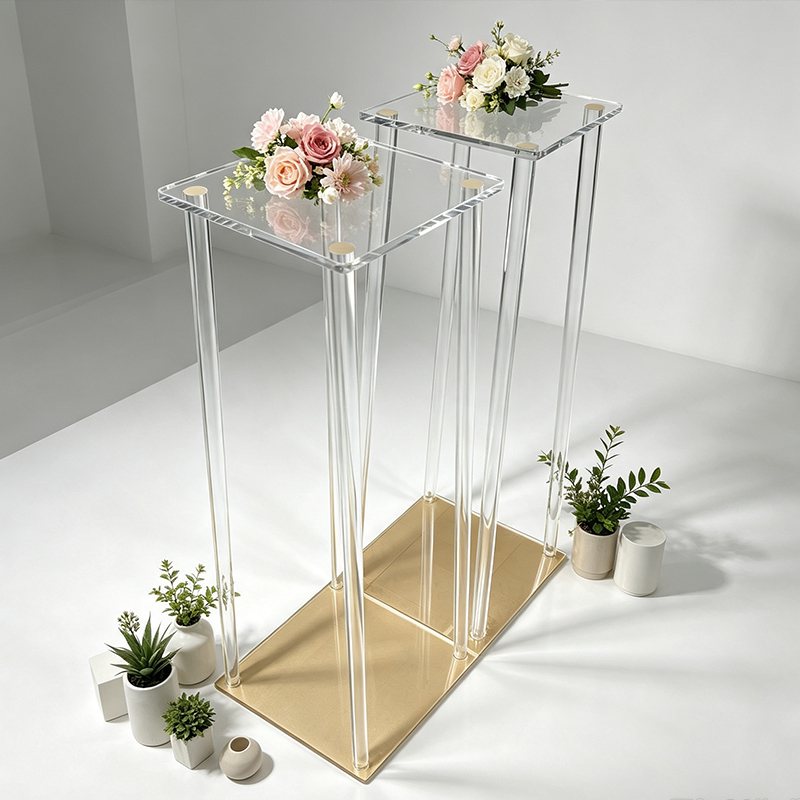
Wedding flower stand
Aisle and banquet flower stands on clear columns, load-tested, knocked down for transport.
02 / Home
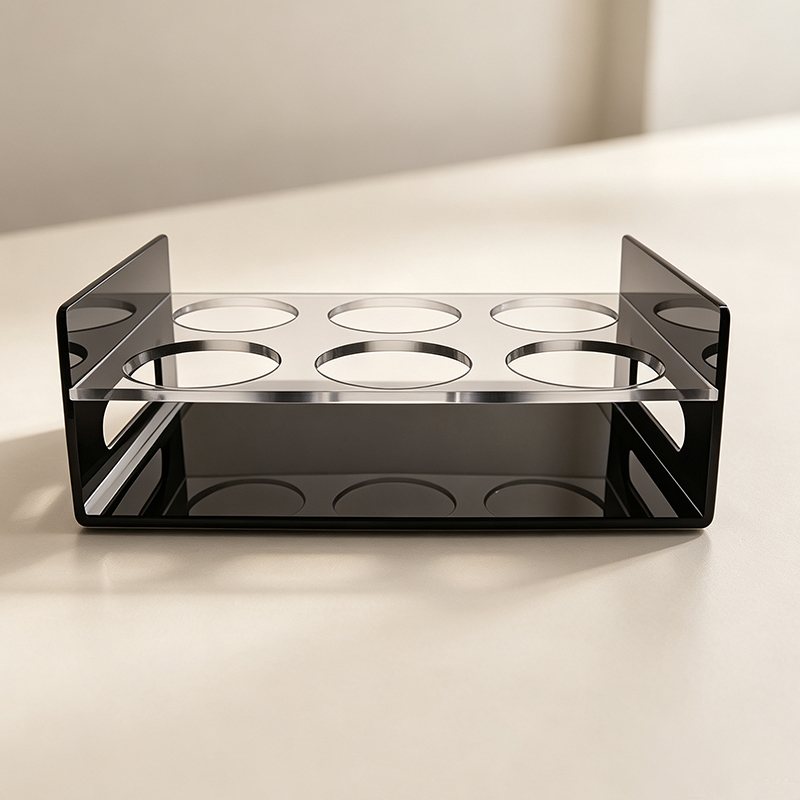
Wine and beverage tray
Thick-based tray with non-slip liner and cup wells cut to glass diameter, for bars and hotel rooms.
02 / Home
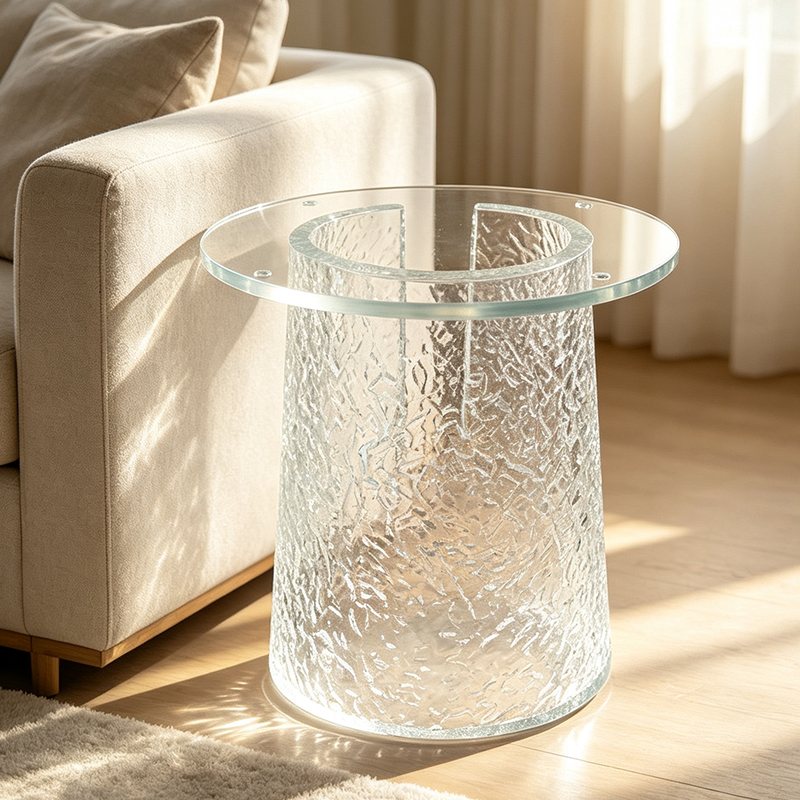
Bent acrylic coffee table
20 mm sheet heat-bent into legs, solvent-bonded to the top with no visible seam, edges diamond-polished.
02 / Home
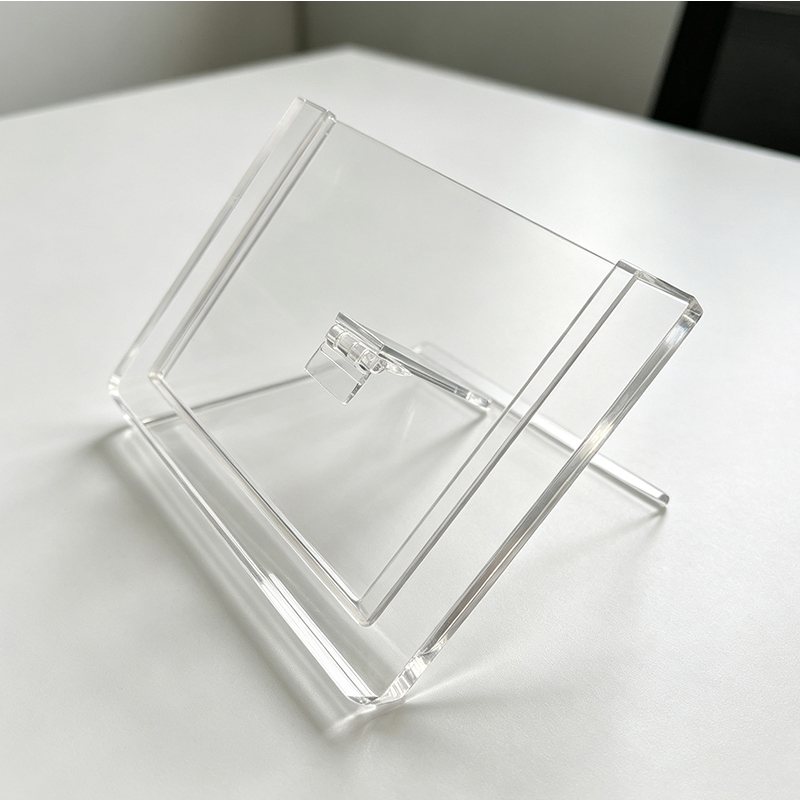
Desktop acrylic calendar
Corporate calendar and ad gift, one-piece bent base, replaceable leaves, UV-printed logo.
02 / Home
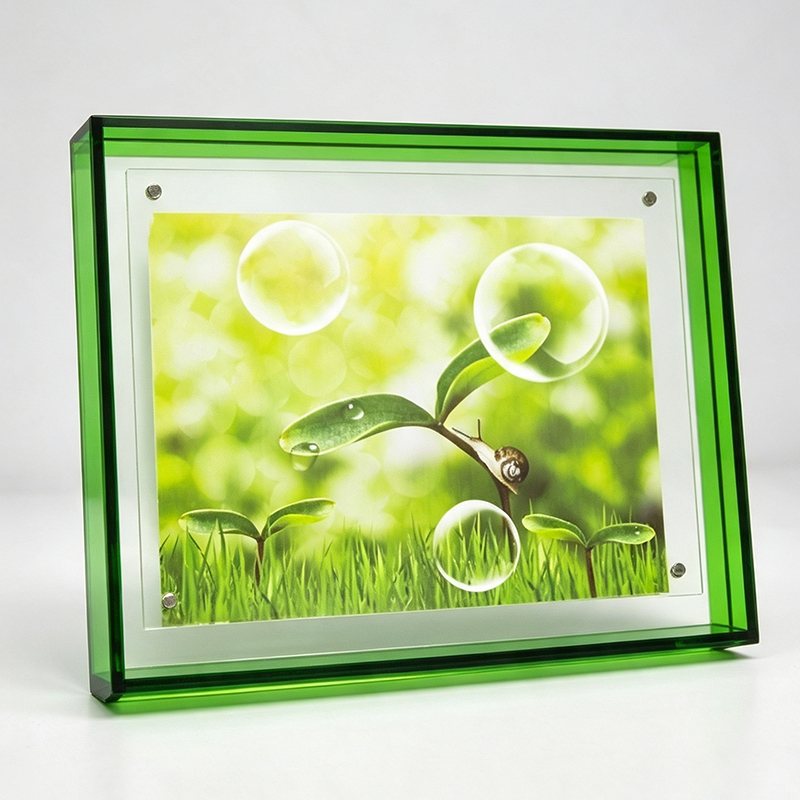
Acrylic photo frame
Stand or wall mount, magnetic or slot construction, clear on both faces, 5×7 up to A3.
02 / Home
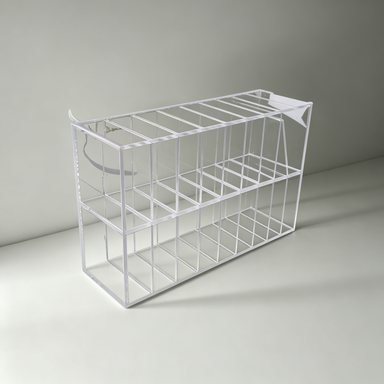
Wall-mounted multi-grid rack
Wall rack with sized compartments for samples, hung on concealed fixings that stay off the sight line.
02 / Home
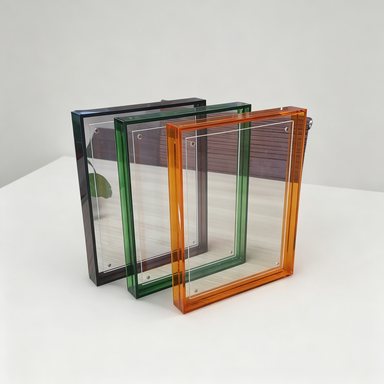
Colour magnetic photo frame
Coloured sheet with a magnet closure and no adhesive; swap the print without opening the frame.
02 / Home
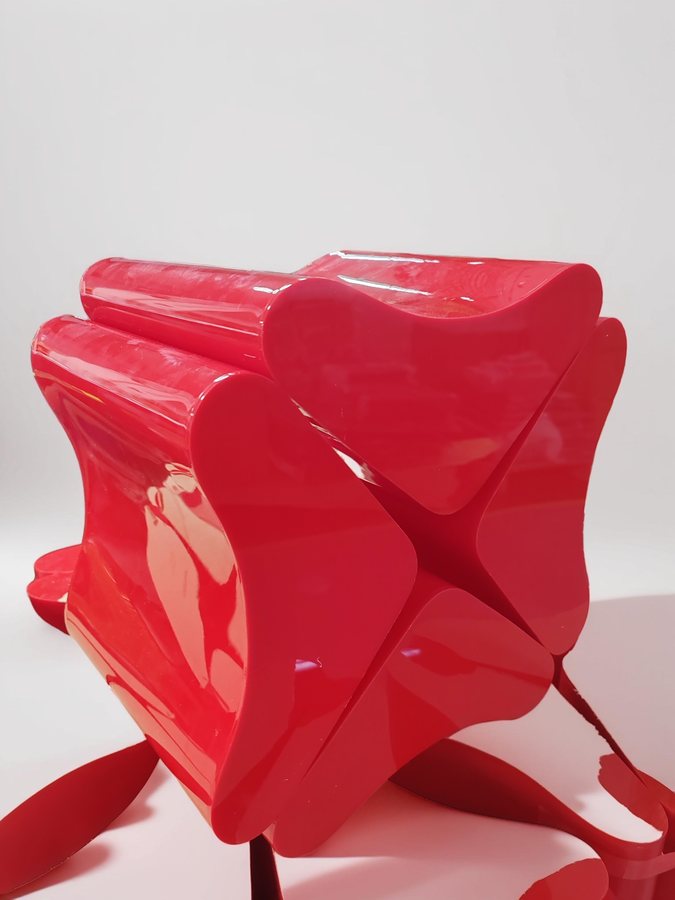
Sculptural acrylic object
CNC-routed and heat-formed in one piece; gradient, laminated colour and subsurface engraving available.
02 / Home
What this line covers
Hospitality and residential pieces share one constraint: they are looked at closely and touched often. Here is the range, and the engineering each type needs.
The largest piece is a bent acrylic coffee table, normally 15–25 mm cast sheet with a 40–60 mm bend radius, annealed after forming so the bend does not craze months later. The same construction scales down to a side table or a sculptural plinth. Storage and service pieces are the next group: a wine rack built as a 45-degree lattice or a scalloped cradle, a wine and beverage tray with recessed glass positions and a non-slip base, and a room-service tray with a 25 mm rim that actually holds crockery.
Display and tabletop pieces form the third group. A photo frame is a bonded sandwich with a machined rebate for the print and no visible fixing; a desktop calendar is a single-piece bend with swappable inserts; a flower stand is a tall column on a ballasted base, because a 1,200 mm stand on a 300 mm foot will go over. For hospitality fit-outs we also build podiums and lecterns, menu holders and sign holders — pieces where the design job is to be almost invisible.
| Piece | Sheet and construction |
|---|---|
| Bent acrylic coffee table | 15–25 mm, radius 3x thickness, annealed after bending |
| Wine rack | 8 mm lattice with 6 mm slots at 45 degrees, or 6 mm bent cradles; pocket cut 4 mm oversize for bottle variation |
| Wine and beverage tray | 5 mm base, 25 mm rim, 40 mm corner radius, non-slip insert |
| Photo frame | 5 mm bezel bonded to a 3 mm back with a machined print rebate; magnetic or easel stand-off |
| Flower stand | 15 mm column, base 40 percent of height, 8–12 kg ballast for a floor piece |
| Podium or lectern | 15 mm body, 45-degree reading slope, 8 mm shelf with 20 mm lip, machined cable route |
| Menu holder | 3 mm L-shape or 5 mm handled unit; 15 degrees for a table menu, 30 degrees for a counter |
| Sign holder | 3 mm tent or L-shape; the design goal is to disappear |
Every piece in this line leaves the plant with a felt or cork base bonded on, because an acrylic object on a hard floor slides and sounds hollow. That single detail is what separates a hotel-grade piece from a prototype.
What to put on the drawing for a hospitality piece
| Callout | What we need | Why it matters here |
|---|---|---|
| Sheet thickness | Per part, and the span it has to carry | Span divided by 40 sets thickness; a 1,200 mm table needs 25 mm or a rib |
| Bend radius | Inner radius per bend | Minimum is about 3x thickness; tighter will mark or craze |
| Annealing | Confirm it is required on any bend over 10 mm | This is the step that prevents a crack in month three |
| Seam location | Which faces are sight lines | A seam on a front face reads under any lighting |
| Base treatment | Felt, cork, or ballast | A tall piece needs 8–12 kg or it tips when leaned on |
| Cleaning | What housekeeping will use | Daily alcohol sanitiser crazes acrylic; soap and water does not |
For a piece that will sit in a public area, the two callouts that matter most are not on the drawing at all: the cleaning agent and the ballast. A correctly specified table cleaned with the wrong chemical fails in a year, and a correctly built stand on too light a base goes over the first time a guest leans on it.
How far this line can be pushed
Standard practice, the practical ceiling, and what each step up costs. Quotations are built from your drawing, not from this table.
| Requirement | Standard | Available | Cost / lead impact |
|---|---|---|---|
| Thickness | 15–20 mm tables, 8 mm trays, 5 mm frames | 3–30 mm | Above 30 mm is mill order, +5 days |
| Bending | Single radius, 4-hour anneal | Multi-segment curves and compound radii | Complex curves need a form, +3–5 days |
| Base | Felt pads | Cork, silicone, metal glides | Metal glides sourced in |
| Surface | Clear or solid colour | Gradient, laminated colour, zoned frosting | Laminating adds roughly 20% to unit price |
| Packing | PE foam in a rigid carton | Timber crate, custom inserts | Crates priced per piece |
FAQ
Questions we get on this line
Will a thick bent table crack?
Not if it is annealed. Stress concentrates in the bend, and annealing means a programmable oven with a slow ramp down. Parts that skip it typically crack one to three months after delivery.
How much load will it take?
A 20 mm top on two supports handles 60 kg uniformly without issue. Cantilever beyond 300 mm needs thicker sheet or internal reinforcement — we size it to the span.
Does acrylic scratch easily?
More easily than glass. Light marks polish out with compound; deep ones come back to the shop. Clean with a soft cloth and neutral detergent, never ammonia or alcohol.
Can it go outdoors?
Yes with UV-stabilised cast sheet, away from sustained high heat. Yellowing outdoors is gradual and becomes visible in three to five years — that is the material, not the process.
The other three lines
The same sheet against a different set of acceptance criteria.
Send the requirement, get a concrete plan
A drawing, a sample, or a few reference photos are all fine. Reply within one working day, with a price band and a schedule.